Can an Esthetician Do Microneedling in My State?
The answer to this is actually simpler than it looks, but it is also genuinely technical, and the reason people find it confusing is that they are asking the wrong question. The question is not whether estheticians can do microneedling. It is whether your state allows a physician to delegate it, because that turns out to be the thing that varies.
Once you see that, most of the map stops looking arbitrary.
Two mechanisms, not one rule
Microneedling authority works in two ways, and they are separate.
There is what your esthetics licence permits on its own. Every state draws that line in roughly the same place: work on the surface of the epidermis is cosmetology, and anything that punctures, wounds, or destroys living tissue is the practice of medicine. Microneedling punctures living tissue, so on almost every reading it sits on the medical side of that line.
Then there is whether your state allows a physician to hand that authority down to you through delegation. Some states do, with conditions. Some states do not, at all.
So an esthetician performing microneedling legally is usually not doing it because the licence covers it. They are doing it because a physician delegated it under a structure the state recognises. Those are two completely different sources of authority, and almost every confusing answer you will read online comes from someone collapsing them into one.
What that looks like in practice
Take two states.
In California, the Board of Barbering and Cosmetology has been explicit that microneedling sits outside the esthetics scope of practice, precisely because it punctures living tissue. And California does not offer a delegation route for it. So a California esthetician performing microneedling is practising medicine without a licence, regardless of what training they hold or who told them it was fine.
In Texas, the starting point is identical. The Texas Department of Licensing and Regulation governs cosmetology, the Texas Medical Board governs medicine, and microneedling falls on the medicine side. But Texas permits physician delegation. An esthetician can perform microneedling inside a med spa provided a physician delegates through written protocol, the staff have documented hands-on training, and a physician or midlevel practitioner is on site or available for emergencies.
Same treatment, same qualification, opposite answers. The variable is not competence or safety training. It is whether the state built a delegation door.
Depth is the other variable
Some states resolve this differently again, by drawing a line at needle depth rather than at delegation.
The reasoning is that very shallow work stays within the epidermis and therefore stays cosmetic. Where states take this approach, you will see a depth threshold written into the rules, often capped around 0.25mm and generally under 0.3mm for what counts as cosmetic. Anything deeper is treated as medical, because the needle is reaching the dermis, which is the whole point of microneedling for collagen remodelling.
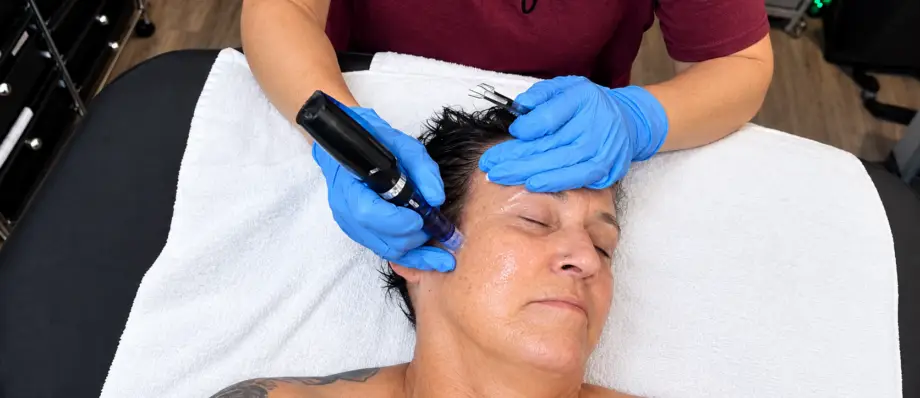
This is worth knowing because it explains a device category that otherwise makes no sense. Shallow cosmetic microneedling pens exist specifically to sit under those thresholds, and they are legitimately different from what is being done at medical depth even though the marketing photographs look identical.
But that does not mean you should assume your state uses the depth approach. Many do not, and buying a device on the assumption that shallow equals permitted is how practitioners end up out of scope with equipment they have already paid for.
How to get your own answer
You want to make sure you check both boards, not one, because the answer usually lives in the gap between them.
Start with your cosmetology board. Search your state’s name plus “board of cosmetology,” or work from the directory of state boards. Find the administrative code or the rules document rather than the FAQ page, because FAQ pages are frequently years out of date and the statute is the thing that governs.
Search that document for the treatment and for the language. Look for “microneedling,” and also for “living tissue,” “epidermis,” and “dermis.” The wording around those terms is where the boundary actually gets drawn, and it will often answer the question even where microneedling is never named.
Then check the medical board. This is the step most people skip, and it is where delegation rules live. If the cosmetology board says microneedling is out of scope, that is not the end of the answer, because the medical board may permit delegation under conditions. Search your state’s name plus “medical board” plus “delegation.”
If it is still unclear, write and ask. Most boards will answer a written scope question. Ask in writing so that you have the answer in writing, which matters a great deal if it is ever disputed.
Note the date on whatever you find. Rules move by legislative session. California added dermaplaning to esthetics scope in January 2022 through Senate Bill 803, which is a reminder that these boundaries are not fixed. An answer from 2023 may not hold today.
For consumers: one question
If you are booking rather than performing, you do not need any of the above. You need one question, asked before anything happens:
What licence do you hold, and under whose authority are you performing this treatment?
A practitioner operating lawfully answers that immediately. And it matters beyond the technicality, because professional liability insurance typically excludes treatments performed outside scope of practice. If something goes wrong during a treatment that should not have been performed, there may be no coverage to claim against. That becomes your problem rather than only theirs.
For professionals: the mistake that costs most
I want to head off the conclusion people most often reach here, because it is the expensive one.
Completing a microneedling certification does not make microneedling legal for you. Training providers sell courses nationally, into states with completely different rules, because what they are selling is education rather than authority. The certificate is real. It just is not a permission slip, and your state board does not care that you have one.
Check your state before you book the course. Not after, and not after you have bought the device.
The second thing worth saying plainly: a physician’s name on the wall is not delegation. Where delegation exists it has structure, meaning a written protocol, documented training, defined emergency availability, and a real supervisory relationship. If that paperwork does not exist, the authority does not exist either, and boards discipline the practitioner rather than the employer.
What this comes down to
Microneedling authority is not one rule, it is two: what your licence covers, and whether your state lets a physician delegate past it. Almost every confusing answer online comes from treating those as the same thing. Check both boards, note the date, and get anything ambiguous in writing.
That is the whole question, broken down as simply as I can put it.
Common questions
Can an esthetician do microneedling?
It depends on your state and on the source of authority. California prohibits it for estheticians with no delegation route available. Texas permits it under written physician delegation inside a med spa. Other states set a needle depth threshold instead, often around 0.25mm, below which shallow work is treated as cosmetic. Check your own state’s rules rather than assuming.
What needle depth can an esthetician use?
Where states use a depth threshold, cosmetic work is generally capped under 0.3mm and sometimes at 0.25mm, on the reasoning that shallow treatment stays within the epidermis. Not every state takes this approach, so confirm whether yours draws the line at depth, at delegation, or prohibits it outright.
Why is microneedling legal in one state and not another?
Because states differ on delegation, not on the underlying principle. Nearly all treat puncturing living tissue as the practice of medicine. What varies is whether a physician may delegate that authority to an esthetician, and under what supervision conditions. That single variable produces most of the apparent inconsistency.
Does a microneedling certification let me perform it?
No. Certification is education, not authority. Training providers sell courses nationally into states with different rules, and your state board decides what your licence permits. Check your state’s scope rules before booking a course or buying a device.
What happens if an esthetician performs microneedling out of scope?
Professional liability insurance typically excludes out-of-scope treatments, so a bad outcome can become a personal liability rather than an insurance claim. Boards discipline the practitioner rather than the employer, so being instructed to perform it is not a defence. Enforcement usually begins with a complaint from a client or a competitor.
How do I find out my state’s rules?
Check two places. Your cosmetology board’s administrative code, searching for “microneedling,” “living tissue,” “epidermis,” and “dermis.” Then your medical board, searching for delegation rules. If it is still unclear, write to the board and keep the reply.
For consumers: browse professionals whose licences and credentials we have verified. Find a skin pro
Sources: