
How to Find a Skincare Professional You Can Actually Trust
The fastest way to find a skincare professional you can trust is to check three things before you book: that their licence is current and verifiable through your state board, that they treat your specific concern regularly rather than occasionally, and that they ask about your medical history before touching your face. Most people skip all three and pick whoever has the nicest Instagram.
That is not a criticism. Nobody teaches you how to vet an esthetician. There is no equivalent of asking a friend for a dentist recommendation, because skincare sits in a strange gap between healthcare and beauty, and the industry does very little to help you tell the difference between someone excellent and someone confident.
So here is how to actually do it.
Why the usual method fails
Most people find a skincare professional one of three ways. They search “facial near me” and pick from the top of the map. They see a spa on Instagram with good photography. Or a friend mentions someone.
The friend method is decent. The other two are close to random.
Search rankings reflect advertising spend, review volume, and proximity. None of those measure whether the person is good at treating melasma on deeper skin tones. Instagram measures photography and posting frequency. Some of the most skilled estheticians I have come across have terrible websites and no social presence at all, because they have been fully booked on word of mouth for fifteen years and never needed one.
The gap between how good someone is and how findable they are is enormous in this industry. Closing it is the entire reason this directory exists.
Step one: verify the licence
Every state requires estheticians to hold a licence to perform facials, extractions, and waxing professionally. Getting one means accredited training hours and a state board exam.
You can check any licence yourself, free, in about two minutes. Every state board publishes a public lookup. Search your state’s name plus “board of cosmetology license lookup,” or start from the national directory of state cosmetology boards. Type in the professional’s name and the licence should come back with a status and an expiry date.
Two things to look for. The status should say active, not expired or lapsed. And the licence type should say esthetics, not just cosmetology.
That second point catches people out. A cosmetology licence covers hair and includes some skin training, but far fewer hours devoted to it. Someone can legally call themselves a skincare professional on a cosmetology licence alone. If you are booking a peel, you want an esthetics licence.
If you cannot find them, ask. A licensed professional will tell you their licence number without hesitating, because they are proud of it. Hesitation is the answer.
Step two: match the specialty to your concern
This is the step that changes results most, and almost nobody does it.
Estheticians are not interchangeable. Someone who spends every day treating acne develops a completely different skill set from someone who does brows and relaxation facials. Both can be excellent. Only one of them is right for your cystic breakouts.
Think about what you actually want fixed, then find someone who works on that specific thing regularly. If your concern is:
Acne or persistent congestion, look for someone who lists acne as a specialty and can talk about the difference between hormonal, fungal, and comedonal presentations. Ask how many acne clients they see a week.
Pigmentation, melasma, or dark spots, ask specifically about experience with your skin tone. This matters more here than anywhere else. Deeper skin tones carry a higher risk of pigmentation being triggered by treatment rather than resolved by it, and a practitioner who has not worked extensively with Fitzpatrick IV to VI skin can make things worse while trying to help.
Rosacea or sensitivity, find someone who talks about calming and barrier support rather than resurfacing. The wrong approach here flares things badly.
Skin affected by cancer treatment, you need an oncology-trained esthetician specifically. This is a real, separate certification covering which products and modalities are unsafe during and after treatment, how to work around ports and surgical sites, and when to refer back to the medical team. Standard training does not cover it in any depth.
Ask directly: how often do you treat this? A good answer sounds like “three or four clients a week, it’s most of what I do.” A vague answer is also an answer.
Step three: read the credentials properly
Beyond the state licence, estheticians collect certifications. Most people see a string of acronyms and assume they all mean the same thing. They do not.
The ones worth recognising:
NCEA Certified is the National Coalition of Estheticians Associations credential, and it is the closest thing the US industry has to a recognised advanced standard. It requires 1,200 hours of training or equivalent experience.
CIDESCO is an international diploma, Swiss-based, widely regarded as the most rigorous general esthetics qualification available. Someone holding it has done substantially more than the minimum.
ITEC is a British qualification, common among practitioners trained in the UK or Commonwealth countries.
Oncology esthetics certification comes from a handful of specific training providers and is worth verifying by name.
Manufacturer certifications, meaning training in a particular product line or device, are a different category. They tell you someone knows that brand’s protocol. They do not tell you much about skin knowledge generally. Not worthless, just narrower than they look on a website.
A wall of acronyms is not automatically better than one meaningful credential and fifteen years of practice. But someone who has invested in advanced training has told you something about how seriously they take the work.
Step four: judge the consultation, not the decor
Here is the strongest single predictor of a good outcome, and it costs you nothing to assess.
Before anyone touches your face, you should be asked about:
- Medications you are taking, particularly isotretinoin, blood thinners, and anything photosensitising
- Recent sun exposure
- Retinoid or acid use at home
- Any history of cold sores
- Previous reactions to treatments or products
- Recent procedures, including injectables
- What you are actually hoping to change
If nobody asks any of this and you go straight onto the bed, that tells you the treatment is a fixed protocol rather than a response to your skin. It also creates real risk. A peel on skin that has been using tretinoin for three weeks is a different proposition from a peel on skin that has not.
An expensive spa with a beautiful lobby and a rushed forty minute protocol will do less for your skin than a modest room where someone takes their time. Judge the questions, not the candles.
Step five: know the red flags
Some of these are dealbreakers. Some just mean adjust your expectations.
Walk away from:
Anyone who guarantees results. Skin does not work that way, and the claim itself is a regulatory problem for them.
Anyone who cannot or will not tell you their licence number.
Anyone offering injectables, lasers, or medical-depth treatments without a clear answer about who is supervising and what licence they hold. Scope of practice varies enormously by state, and the person who is vague about it is usually vague for a reason.
Prices dramatically below the local rate for device-based or injectable treatments. That usually means diluted product, an inexperienced operator, or a device being run by whoever was free.
A consultation that is mostly a product pitch.
Proceed with caution when:
They dismiss your concern rather than explaining it.
They recommend an aggressive treatment at a first appointment without seeing how your skin responds to something gentler.
They cannot explain why they are choosing a particular treatment for you specifically.
They talk over you.
Step six: read reviews for the right things
Star ratings are close to useless in this industry. Almost everyone sits between 4.6 and 5.0, because unhappy skincare clients tend to quietly disappear rather than write reviews.
Read the text instead, and look for:
Reviews mentioning your concern by name. Ten five-star reviews about a relaxing facial tell you nothing about whether this person can handle melasma.
Repeat clients. “I’ve been seeing her for four years” is worth more than twenty first-visit reviews.
Reviews describing being told no. When someone writes “she told me I wasn’t a good candidate for the peel and suggested something else,” that is a professional who prioritises outcomes over revenue. Rare and valuable.
Specific outcomes over general praise. “My skin texture changed after the third session” beats “amazing experience.”
Ignore reviews about parking, ambience, and how nice the towels were.
What it should cost, and what that buys
Price is a poor proxy for skill, but it is not meaningless, and knowing the local range stops you being overcharged or lured somewhere you should not go.
A professional facial in most US metros runs somewhere between 90 and 200 dollars for 60 to 75 minutes. Specialist treatments, acne protocols, and peels usually sit higher. Rural and suburban pricing runs lower, sometimes considerably.
What should worry you is the bottom of the range on anything device-based or injectable. A price well under the local rate for laser or injectables usually means one of three things: diluted product, an inexperienced operator, or a device being run by whoever happened to be free. This is not the service to bargain hunt.
What you are paying for at the higher end should be time and attention, not decor. A 90 minute appointment with a proper consultation and a practitioner who adjusts as they go is worth more than a 45 minute fixed protocol in a nicer room. Ask how long the appointment is and how much of it is consultation.
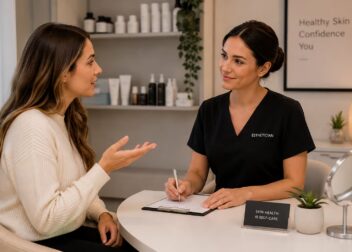
One more thing worth knowing: a consultation-only appointment is often available, sometimes free, sometimes 30 to 50 dollars credited against a first treatment. If you are nervous, or your concern is complicated, book that instead of a treatment. You learn more about whether this is the right person from twenty minutes of conversation than from an hour of being worked on.
If you are not in a big city
Most advice about choosing a professional assumes you have twenty options. Plenty of people have three.
A few adjustments when the pool is small.
Widen the radius before lowering the bar. An hour’s drive to someone who genuinely treats your concern beats a local generalist, particularly for a course of treatment where the first two appointments matter most. Many people do the assessment appointments further afield and the maintenance closer to home.
Ask your nearest option who they would send you to. Good practitioners know who else is good, and referring you on costs them a booking, which is why the answer tends to be honest.
Check whether anyone nearby has specialist training even if they do not advertise it. Oncology certification in particular often goes unmentioned on websites, because practitioners assume nobody is searching for it. Phone and ask directly.
And consider that a video consultation with a specialist, paired with treatment from a local generalist who is willing to follow a plan, works better than people expect for pigmentation and acne protocols.
What verification should actually mean
Most directories verify that a business exists and pays for a listing. That is a low bar, and it is why searching for a skincare professional feels like guessing.
Verification should mean someone checked the licence, confirmed the credentials claimed are credentials held, and can vouch that the practitioner does what the listing says they do.
Skin Pro Finder came out of The Skin Games, an international skincare competition that has been running for nine seasons. Licensed estheticians compete in front of expert judges, on stage, under time pressure, on real skin. We have watched a lot of these professionals work in conditions where you cannot hide behind good lighting and a well-written bio.
That is a different kind of knowledge than reading a submitted form. It is the reason we can say a listing is verified and mean something specific by it.
The short version
Check the licence yourself. It takes two minutes and it is free.
Find someone who treats your concern regularly, not someone who lists it among twenty services.
Judge the consultation. If nobody asks what medications you are on, that is your answer.
Read reviews for mentions of your concern and for repeat clients.
And if a practitioner tells you that you are not a good candidate for what you asked for, take them seriously. That is usually the person worth booking with.
Browse verified skincare professionals near you, filtered by specialty and location. Every professional listed has been manually checked by The Skin Games.