How to Check If Your Esthetician Is Actually Licensed
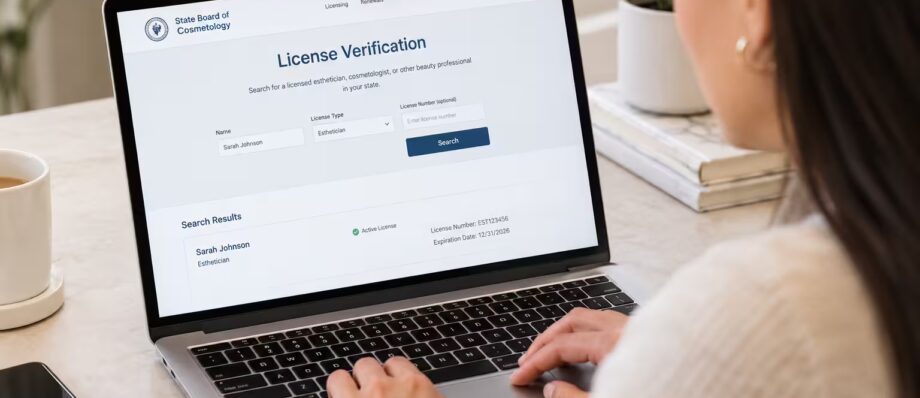
You can check any esthetician’s licence yourself, free, in about two minutes. Go to your state’s cosmetology board website, find the licence lookup, and type in their name. You are looking for two things: a status that says active, and a licence type that says esthetics rather than only cosmetology.
That is the whole process. It costs nothing, nobody finds out you did it, and almost nobody does it.
I have been an esthetician for over ten years and I have run a competition for over ten where we verify credentials for a living, across entrants from more than 24 countries. The thing that still surprises me is how rarely clients check. People will research a restaurant for twenty minutes and then let a stranger put acid on their face because the Instagram was pretty.
What a licence actually tells you
A licence is a floor, not a ceiling. It tells you someone completed accredited training hours and passed a state board exam. It does not tell you they are good.
But the floor matters more than people think, because of what the training covers. Sanitation and infection control. Contraindications, meaning the conditions and medications that make a treatment unsafe. What is legally inside the scope of the licence and what is not. Basic skin anatomy.
Someone working without a licence has not been tested on any of that. They may still be talented. They have not been tested.
The two minute check
Step one. Find your state’s board. Search your state’s name plus “board of cosmetology license lookup.” Some states run it through a Department of Licensing and Regulation, or a Department of Health, or a Board of Barbering and Cosmetology. The naming varies. The lookup exists everywhere.
Step two. Search the name. Use the name on their licence, which may not be the name on their Instagram. If you cannot find them, try a business name search, or ask them directly for the licence number.
Step three. Read what comes back. Three fields matter.
Status. Active is what you want. Expired, lapsed, suspended, or revoked all mean stop.
Licence type. This is the one people miss. Esthetics is what you want for skin. A cosmetology licence covers hair and includes some skin training, with far fewer hours devoted to it. Someone can legally offer skincare services on a cosmetology licence alone in most states. For a facial, that may be fine. For a peel, I would want the esthetics licence.
Expiry date. Licences renew on a cycle, usually every one to two years, and renewal typically requires continuing education. A licence that expires next month is worth a question.
Step four. If something looks wrong, ask. Names change. People move states. A licence under a maiden name or an old address is common and innocent. Give them the chance to explain before you assume.
What to do if you cannot find them
Ask for the number directly.
I know this feels awkward. It is not. Every licensed professional I know is proud of that licence, because the training was expensive and the exam was hard, and they will give you the number without blinking.
The reaction is the information. Someone who answers immediately has told you one thing. Someone who gets defensive, deflects, or explains why the question is unnecessary has told you something else, and you found it out before you were on the table rather than after.
Beyond the licence
Once you have confirmed the floor, the more useful question is what they have built on top of it.
NCEA Certified is the National Coalition of Estheticians Associations credential, and it is the closest thing we have in the US to a recognised advanced standard. It requires 1,200 hours of training or equivalent experience.
CIDESCO is an international diploma, Swiss-based, and widely regarded as the most rigorous general esthetics qualification available anywhere. Someone holding it has done substantially more than their state required.
ITEC is a British qualification, common among practitioners who trained in the UK or Commonwealth countries.
Oncology esthetics certification is a separate specialist credential covering how cancer treatment affects skin and which treatments become unsafe. Ask where they trained. Oncology Training International is the main US provider.
Then there are manufacturer certifications, meaning training in a specific product line or device. Those tell you someone knows that brand’s protocol. Useful, narrower than they look on a website.
A wall of acronyms is not automatically better than one meaningful credential and fifteen years of hands-on practice. But someone who invested in advanced training has told you something about how seriously they take this.
Why we built verification into a competition
When we started The Skin Games eleven years ago, the idea was simple. Give estheticians eight weeks to produce a documented result on a real client, with weekly video diaries and before-and-after documentation, and let expert judges assess it like a case study.
What I did not expect was how much that format reveals.
You cannot fake eight weeks of documented work. You cannot hide behind good lighting and a well-written bio when a panel of judges is looking at your protocol decisions week by week. Practitioners who compete are putting their actual skill in front of people qualified to assess it, voluntarily, which is a different kind of evidence than a certificate.
That is why Skin Pro Finder exists as a separate thing. We already knew a lot of these professionals. Verifying a licence is the minimum. Having watched someone work is better.
The people who taught me this matters
I want to name a few people, because I did not work any of this out alone.
Christine Heathman at GlyMed and Kelly Anderson at California Skincare both spent years telling anyone who would listen that the gap between a licensed professional and an unlicensed one is a safety issue rather than a snobbery issue. Holly Brown and Cheryl Miller have made the same case from the education side. And my husband Frank, who is always the person I forget to mention first, has kept the standards conversation at the centre of TSG when it would have been easier to just run a competition.
None of them get asked to verify their credentials as often as they should.
What this protects you from
Three things, in order of how often they come up.
Infection. Sanitation and sterilisation are the least glamorous part of the training and the part that matters most. Extractions, dermaplaning, and waxing all create entry points.
Treatment on skin that should not have it. Isotretinoin, blood thinners, recent procedures, active cold sores, certain medications. A trained practitioner asks before starting. An untrained one does not know to.
Work outside scope. If someone performs a treatment their licence does not cover, their professional liability insurance typically will not cover it either. That becomes your problem, not just theirs, because there may be nothing to claim against.
Common questions
How do I check if an esthetician is licensed?
Search your state’s name plus “board of cosmetology license lookup,” then enter the practitioner’s name. Every state publishes a free public database. Check that the status reads active and that the licence type says esthetics rather than only cosmetology. It takes about two minutes and nobody is notified that you looked.
What is the difference between an esthetics licence and a cosmetology licence?
A cosmetology licence covers hair and includes some skin training, with far fewer hours devoted to it. An esthetics licence is specific to skin. Someone can legally offer skincare on a cosmetology licence alone in most states. For facials that may be fine. For peels or anything treating a concern, look for esthetics.
Is it rude to ask an esthetician for their licence number?
No. Licensed professionals are proud of that licence and hand over the number without hesitating. The reaction tells you more than the number does, and you find it out before you are on the table rather than after.
What if their licence is expired?
Ask before assuming. Licences renew on a cycle and administrative lapses happen, particularly around a move or a name change. An expired licence with a good explanation and a renewal in progress is different from an expired licence with a shrug. Do not book a treatment until it is current.
Does a licence mean someone is good at their job?
No. A licence is a floor, not a ceiling. It confirms accredited training in sanitation, contraindications, and scope, and that a state exam was passed. Skill comes from what they built on top of that, which is where advanced credentials like NCEA or CIDESCO, and years of hands-on practice in your specific concern, matter.
What should I do if I think someone is working without a licence?
Do not book with them. If you have already been treated and something went wrong, you can file a complaint with your state board, which has jurisdiction over licensed practitioners and, in most states, an enforcement route for unlicensed practice. Document what happened and when.
Browse professionals whose licences and credentials we have already verified.