What Estheticians Can and Can’t Legally Do: A State-by-State Guide
There is no national answer to what an esthetician may legally do. Licensing sits with individual states, and the same treatment, performed by someone holding the same qualification, can be perfectly legal in one state and unlicensed practice of medicine in the next.
That sounds like a technicality. It is not. It determines who is allowed to point a laser at your face, whether the person doing your microneedling is operating lawfully, and whether their insurance would pay out if something went wrong.
This guide explains the principle every state applies, walks through two states in detail to show how differently it plays out, and gives you a method for checking your own state in about ten minutes.
The principle every state uses
Regulators mostly do not care what a treatment is called on the menu. They care about one question:
Does the treatment penetrate or remove living tissue?
Work on the surface of the epidermis is cosmetology, regulated by a cosmetology or barbering board. Anything that punctures, wounds, or destroys living tissue below the epidermis is the practice of medicine, regulated by a medical board, regardless of who performs it or what it is marketed as.
Almost every rule that looks arbitrary makes sense once you apply that test.
A superficial glycolic peel acts on the epidermis, so it is cosmetology. A medium-depth peel intentionally destroys living tissue in the dermis, so it is medicine. Microdermabrasion abrades the surface, so it is cosmetology. Microneedling punctures living tissue, so in many states it is medicine. Waxing removes hair from the follicle mechanically, so it is cosmetology. Laser hair removal destroys the follicle with thermal energy, so it is usually medicine.
Where states genuinely differ is not on the principle. It is on whether a physician can delegate medical procedures to an esthetician, and under what conditions. That single variable produces most of the confusion in this industry.
Two states, same treatment, opposite answers
California: a hard line, no delegation route
California estheticians are regulated by the Board of Barbering and Cosmetology.
In scope: facials, cleansing, manual extractions, mechanical exfoliation including microdermabrasion, superficial chemical peels that act only on the epidermis, masks and topical products, non-laser hair removal by waxing, sugaring, or threading, lash and brow services, makeup, manual lymphatic massage, and non-medical LED therapy.
Dermaplaning came into scope on 1 January 2022 under Senate Bill 803, on the reasoning that it exfoliates the epidermis and removes vellus hair without cutting into living tissue.
Out of scope: medium-depth and deep chemical peels, because they reach the dermis and intentionally destroy living tissue. Microneedling, which the Board has stated plainly sits outside esthetics scope precisely because it punctures living tissue. Lasers and IPL, which fall under the Medical Board rather than cosmetology. Anything penetrating or removing living tissue below the epidermis.
On peels specifically, there is no magic acid percentage that marks the boundary. Legality turns on depth of action, which depends on the acid used, its pH, contact time, and how many layers are applied. A 30 percent solution is not automatically fine and a 50 percent solution is not automatically prohibited.
The important structural point about California: there is no delegation route. A physician cannot authorise a California esthetician to perform microneedling. The treatment is outside the licence, and no amount of supervision changes that.
Texas: the same line, with a delegation door
Texas splits authority between two agencies. The Texas Department of Licensing and Regulation governs cosmetology. The Texas Medical Board governs medicine.
The underlying principle is identical to California’s. Estheticians work on the epidermis and do not penetrate or remove living tissue. In scope: facials, cleansing, microdermabrasion, superficial alpha and beta hydroxy acid peels, manual extractions, masks, and non-laser hair removal.
Out of scope on the esthetics licence alone: microneedling, medium and deep peels, lasers and IPL, injections.
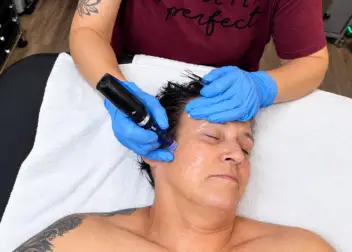
But Texas permits physician delegation. An esthetician working in a med spa may perform treatments that the esthetics licence alone would not authorise, including microneedling, provided a physician delegates through written protocol, staff have documented hands on training, and a physician or midlevel practitioner is on site or available for emergencies.
The authority comes from the delegation, not from the licence.
Texas also has a quirk worth knowing: razor-based dermaplaning requires a Class A Barber licence, and medical scalpel use implicates the Medical Board rather than TDLR. So the treatment California explicitly added to esthetics scope in 2022 sits in a different licensing category entirely one state over.
What the comparison tells you
Same treatment. Same qualification. Two states.
In California, an esthetician performing microneedling is practising medicine without a licence, whatever their training.
In Texas, an esthetician performing microneedling inside a properly structured med spa with written delegation is operating lawfully.
The difference is not competence, training, or safety. It is a structural choice each state made about delegation. Which is exactly why nobody can tell you what estheticians can do without asking where you are.
How to check your own state in ten minutes
You can do this yourself, free, and it is more reliable than any article including this one.
Step one. Find your cosmetology board. Search your state name plus “board of cosmetology” or “board of barbering and cosmetology,” or start from the directory of state cosmetology boards. Some states fold it into a Department of Licensing and Regulation, or a Department of Health.
Step two. Find the scope of practice rules, not the FAQ. Look for the administrative code, statute, or rules document. FAQ pages are often years out of date. The statute is the authority.
Step three. Search that document for the treatment, using the search function. Look for the specific service name and for the phrases “living tissue,” “epidermis,” and “dermis.” The language around those terms is where the boundary is drawn.
Step four. Check the medical board too. This is the step people skip and it is often where the real answer lives. If a treatment is outside cosmetology scope, the medical board decides whether it can be delegated and under what conditions. Search your state name plus “medical board” plus “delegation” plus the treatment.
Step five. If it is still unclear, write and ask. Most boards answer written scope questions. Ask in writing so you have the answer in writing, which matters if it is ever disputed.
Step six. Note the date. Rules change by legislative session. An answer from 2023 may not hold.
For consumers: what to ask, and why
You do not need to memorise your state’s administrative code. You need one question:
“What licence do you hold, and under whose authority are you performing this treatment?”
Ask it before anything device-based, injectable, or described as medical-grade. Ask it politely. A professional operating lawfully answers it immediately and often appreciates being asked.
Three reasons this matters beyond the legal technicality.
Insurance. Professional liability policies typically exclude treatments performed outside scope of practice. If a practitioner is working out of scope and something goes wrong, there may be no coverage at all. That is your problem, not just theirs.
Recourse. If a treatment was performed lawfully and went wrong, you have a complaints route through the licensing board. If it was performed unlawfully, the board may have no jurisdiction over that practitioner for that act.
It correlates with everything else. Practitioners who are careless about scope tend to be careless about patch testing, contraindication screening, and aftercare. It is a useful proxy.
Also worth knowing: a spa’s marketing is not a legal opinion. Businesses advertise services they are not always authorised to perform, sometimes through genuine misunderstanding rather than bad faith. Regulators enforce against practitioners, not against websites.
For professionals: the compliance reality
If you are an esthetician reading this, three things worth being blunt about.
Training does not create authority. Completing a microneedling certification does not make microneedling legal for you. Training providers sell courses nationally into states with different rules, and a certificate is not a licence. Check your own state before you book the course, not after.
Delegation has structure, and the structure is the point. Where delegation exists, it typically requires a written protocol, documented hands on training, defined emergency availability, and a real supervisory relationship. A physician’s name on a wall is not delegation. If the paperwork does not exist, neither does the authority.
Enforcement is not theoretical. In Texas, the Medical Board enforces actively, and violations risk unlicensed-practice findings, discipline from more than one agency, and uninsured liability where the policy excludes out-of-scope treatment. Being uninsured is usually the part that ends a practice.
The commercial argument tends to land harder than the compliance one. Working within scope, and being explicit with clients about where your scope ends, is a differentiator. Clients who have been burned by someone working beyond their competence notice a professional who says “that’s outside what I can do, here’s who you need.”
The treatments people ask about most
Rather than guess at your state, here is what to look for on each.
Microneedling. The most variable treatment in the industry. Some states permit estheticians to perform it at limited depth, sometimes capped around 0.25mm and generally under 0.3mm, on the reasoning that shallow work stays epidermal. Others permit it only under physician delegation. Others prohibit it for estheticians entirely. Check the depth threshold in your state’s rules specifically, because it is often the operative detail.
Chemical peels. Look for language about epidermis versus dermis rather than percentage limits. Most states draw the line at depth of action, not concentration.
Lasers and IPL. Usually medical. Some states permit operation under supervision with certification, some require a medical licence, some are silent, which creates its own risk. Check both boards.
Dermaplaning. Varies more than you would expect for a treatment that seems simple. California added it to esthetics scope in 2022. Texas routes razor-based dermaplaning through barbering. Check yours specifically.
Injectables. Never within esthetics scope in any state. If an esthetician is injecting, something is wrong.
LED therapy, microdermabrasion, extractions, waxing. Generally within scope everywhere, with some variation in what counts as a medical-grade device.
Four myths worth killing
“If I’m certified, I’m covered.” Certification and licensure are different things. A training provider can sell you a microneedling course regardless of where you live, because they are selling education, not authority. Your state decides what your licence permits. Check before you book the course.
“My insurance will handle it.” Professional liability policies typically exclude treatments performed outside scope of practice. That exclusion is the point at which a bad outcome stops being a claim and starts being a personal liability. Read the policy language on scope, not the summary.
“The spa I work at said it’s fine.” Boards discipline practitioners, not employers. If a treatment is outside your scope, the finding lands on your licence regardless of who told you to perform it. Employer instruction is not a defence.
“Nobody actually enforces this.” They do, and increasingly. Texas is a useful example, where the Medical Board enforces actively and violations can produce unlicensed-practice findings, discipline from more than one agency, and uninsured liability. Enforcement often begins with a complaint from a client or a competitor rather than a proactive inspection.
Why the rules look inconsistent
It helps to understand where this patchwork came from, because it explains why the map looks so strange.
Cosmetology licensing developed state by state from the early twentieth century, mostly to address sanitation in barbershops and salons. Medical practice acts developed separately, to define who may treat disease. Neither anticipated a category of treatment that is cosmetic in intent but medical in mechanism.
Then devices arrived. Lasers, radiofrequency, microneedling pens, and medical-grade peels all landed in a gap between two regulatory frameworks written decades earlier, and each state resolved that gap on its own timetable, usually in response to an incident rather than as a considered policy.
That is why some states have detailed rules on microneedling depth and others are silent, and why silence is its own hazard. A treatment nobody has ruled on is not automatically permitted. It is usually assessed against the general principle, which means the living-tissue test decides it after the fact.
It also explains why rules change more often than people expect. California added dermaplaning to esthetics scope in 2022 because the legislature took it up. Somewhere a rule affecting your practice is moving through a session right now.
The honest limitation of this guide
Everything above about California and Texas is verifiable against those states’ boards. Everything about the underlying principle holds broadly.
What this guide does not give you is a definitive answer for your state, because that answer changes with legislative sessions and often depends on how two agencies interpret overlapping authority. Anyone publishing a confident 50-state table without dating it and citing the statutes is asking you to trust a snapshot that may already be stale.
The verification method above will get you a current answer in about ten minutes. That is worth more than a table you cannot date.
For consumers: browse professionals whose licences and credentials we have verified. Find a verified skin pro
For professionals: list your practice and show clients exactly what you are qualified and authorised to do. Add your listing
Sources to cite in-post:
- California esthetician scope of practice 2026
- Texas esthetician scope of practice 2026
- Who can practice microneedling: 50-state legal guide
- Directory of state cosmetology boards
- California Senate Bill 803 (2021-2022)
- Board of Barbering and Cosmetology, SB 803 FAQ
- CA SB 803, chaptered text on LegiScan
- California Department of Consumer Affairs on the SB 803 changes